
Quick Verdict: Lomi vs. Mill at a Glance
Electric food recyclers have transformed kitchen waste management. Instead of waiting months for outdoor piles to break down, these counter and floor-standing units heat, dehydrate, and grind food scraps into dry organic material in hours or days.
Here is how the two market leaders stack up:
Choose Lomi if: You want a compact countertop unit that offers fast speed modes (under 5 hours), can break down Lomi-approved bioplastics, and produces nutrient-rich organic output you can mix directly into garden soil.
Choose Mill if: You want a sleek, high-capacity, floor-standing bin with zero daily hassle, unmatched odor filtration, and an ecosystem where dried grounds are sent back to farms to feed chickens.
Lomi vs. Mill: Feature-by-Feature Comparison
| Feature / Spec | Lomi (Pela) | Mill Food Recycler |
| Form Factor / Placement | Countertop | Floor-standing cabinet |
| Capacity | ~3 Liters (0.8 Gallons) | ~6.5 Liters (1.7 Gallons) |
| Processing Time | 3 to 20 hours (mode dependent) | Continuous (overnight drying, ~8–12 hrs) |
| Bioplastics Supported? | Yes (Lomi-approved PLA/plastics) | No (Food waste only) |
| Odor Control System | Dual activated charcoal filters | Heavy-duty charcoal filter cartridge |
| Noise Level | ~60 dB (similar to a dishwasher) | Very quiet (~40–45 dB) |
| Output Type | Dehydrated grounds or plant food | Dry, fine food grounds |
| Purchase Model | One-time purchase | Upfront device fee or subscription membership |
Deep Dive: Lomi Composter
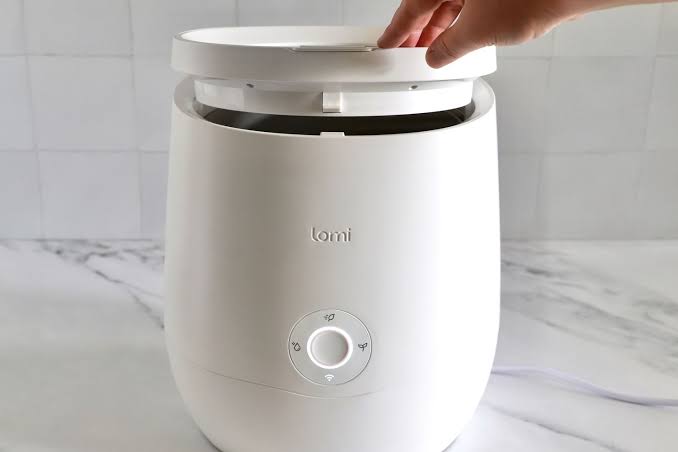
The Lomi (created by Pela) is a compact countertop appliance designed to accelerate the breakdown of household food scraps.
                       +----------------------------------+
                       |          LOMI COMPOSTER          |
                       +----------------+-----------------+
                                        |
             +--------------------------+--------------------------+
             |                                                     |
             v                                                     v
+------------------------------------+   +------------------------------------+
|             ADVANTAGES             |   |            DISADVANTAGES           |
+------------------------------------+   +------------------------------------+
| • Fits directly on kitchen counters |   | • Smaller capacity requires emptying|
| • 3 distinct modes for speed/plants|   |   more frequently                  |
| • Can process bioplastics          |   | • Requires periodic charcoal refill|
| • Faster cycle times (3–5 hours)   |   | • High heat mode degrades microbes |
+------------------------------------+   +------------------------------------+
Key Highlights of Lomi
Three Specialized Operating Modes:
Eco-Express Mode (3–5 hours): Consumes minimal power to quickly dehydrate scraps and reduce volume by up to 80%.
Grow Mode (16–20 hours): Runs at lower temperatures to preserve beneficial soil microbes, creating usable plant food for your garden.
Lomi Approved Mode (5–8 hours): Specifically engineered to break down certified bioplastics alongside food scraps.
Compact & Portable: Sits on your countertop, making it convenient for small kitchens and apartments.
Versatile Soil Output: The low-heat Grow Mode produces nutrient-rich material that can be mixed into potting soil at a 1:10 ratio.
Deep Dive: Mill Food Recycler
The Mill is a premium, floor-standing food recycler built to function like a high-tech trash can. You throw scraps in continuously throughout the week, and Mill processes them quietly overnight.
                       +----------------------------------+
                       |        MILL FOOD RECYCLER        |
                       +----------------+-----------------+
                                        |
             +--------------------------+--------------------------+
             |                                                     |
             v                                                     v
+------------------------------------+   +------------------------------------+
|             ADVANTAGES             |   |            DISADVANTAGES           |
+------------------------------------+   +------------------------------------+
| • Massive capacity (weeks of scraps)|   | • Large footprint (takes floor space|
| • Exceptional odor control         |   | • Cannot process bioplastics       |
| • Seamless "throw-and-forget" feel |   | • Higher long-term subscription/cost|
| • Quiet, low-energy drying cycle   |   | • Output isn't direct compost      |
+------------------------------------+   +------------------------------------+
Key Highlights of Mill
Massive Holding Capacity: Holding 6.5 liters, Mill can take weeks of daily household food waste before needing to be emptied.
Set-and-Forget Convenience: The lid opens with a foot pedal. You throw food in all day, and it automatically heats and grinds overnight, shrinking the contents so you can add more the next day.
Food-Grounds Take-Back Program: Mill offers a unique loop where you can box up your dried food grounds and mail them back (using pre-paid boxes) to be turned into chicken feed, keeping waste out of landfills entirely.
Superior Odor Control: Uses a large charcoal filter cartridge and smart airflow system, keeping odor completely undetectable even when holding food for days.
Key Head-to-Head Differences
1. Capacity & Footprint
Lomi sits on your kitchen counter and holds 3 liters. It is designed for batch processing—fill it up, run a cycle, and empty it.
Mill stands on the floor like a high-end garbage can and holds 6.5 liters. You can add food continuously day after day without emptying it until it fills up weeks later.
2. Speed vs. Continuous Use
Lomi wins on raw speed. Its Eco-Express mode finishes in as little as 3 hours, making it ideal if you need to process waste immediately before guests arrive or to clear counter space.
Mill works continuously in the background. It dries and grinds overnight, freeing up capacity for the next day’s cooking scraps.
3. What You Can Put Inside
Lomi processes standard food scraps AND certified bioplastics (packaging, cutlery, bags certified for Lomi).
Mill handles tough food items (including small bones, avocado pits, and meat) better than most units, but it cannot take bioplastics, paper products, or packaging.
4. Output & Gardening Use
Neither device creates true biological compost on its own (real composting requires moisture, microbes, and time to break down). Both produce dehydrated food grounds.
However, Lomi’s Grow Mode operates at low temperatures to preserve soil biology, making its output safer for direct garden soil amendments.
Mill’s grounds are extremely dry and concentrated; they should either be mailed back through their program or mixed into a traditional outdoor bin or soil bed to cure before planting.
The Verdict: Which One Should You Buy?
Buy the Lomi if:
You want a compact device that stays on your kitchen counter.
You use compostable packaging/bioplastics and want a way to break them down.
You want fast, on-demand processing cycles (3–5 hours).
You want to use the output directly in indoor houseplant soil or garden beds.
Buy the Mill if:
You generate a large volume of food waste and don’t want to empty the bin every day.
You prefer a floor-standing appliance with a hands-free foot pedal.
You want the quietest, most seamless odor control available.
You love the idea of sending food grounds back to farms to support sustainable agriculture.
Frequently Asked Questions
Is the output from Lomi or Mill real compost?
No. Both devices dry and grind food waste into dehydrated scraps. While this drastically reduces landfill volume, true compost requires microbial decomposition over time. For best results in the garden, mix the output with garden soil or add it to an outdoor pile.
Do electric composters smell up the house?
Both appliances use active carbon filters to eliminate odors. If you notice smells coming from your unit, it usually means the charcoal filter needs to be replaced or refreshed. Learn more about managing odor issues in our guide on How to Fix Smelly Compost.
Related Articles & Guides
Looking for traditional composting options? Read our pillar guide on Types of Compost Bins.
Want to know what kitchen scraps are safe for electric composters? Check out What to Put in Compost.


